Montana Mosquito Surveillance
Collection Methods
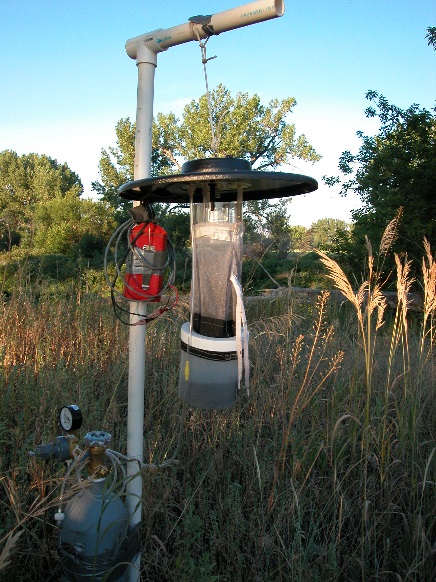
A battery-operated CDC light trap with collection container. Trap site near Wagner, Mont. (Phillips County)
Collection Methods
Mosquitoes were collected using battery-operated CDC light traps with CO2 as an attractant. Light traps were run either one night per week or once every two weeks. Samples were shipped to the Veterinary Entomology Lab where the specimens were identified, counted and potential vectors tested for West Nile virus.
Data Presentation
The mosquito collection data are presented either in a raw data format or standardized as a Trap Index. The raw data are the actual number of mosquitoes trapped per trap night and is influenced by the number of traps set out in a county. The Trap Index is a value calculated by taking the total number of mosquitoes trapped divided by the number of trap nights + the number of traps. Using the Trap Index allows for comparing mosquito catches between counties by taking into account the number of light trap sites and the number of trap nights in a county.
References used for species identification are listed below:
- Carpenter, S. J. and W. J. LaCasse. 1955. Mosquitoes of North America. University of California Press.
- Darsie, R. F. and R. A. Ward. 2005. Identification and Geographical Distribution of the Mosquitoes of North America, North of Mexico. University Press of Florida, Gainesville, Fla.
- Wood, D. M., P. T. Dang, and R. A. Ellis. 1979. The Insects and Arachnids of Canada. Part 6. The Mosquitoes of Canada. Biosystematics Research Institute, Ottawa.